Why Supermarket Builds Go Over Budget
July 1, 2026
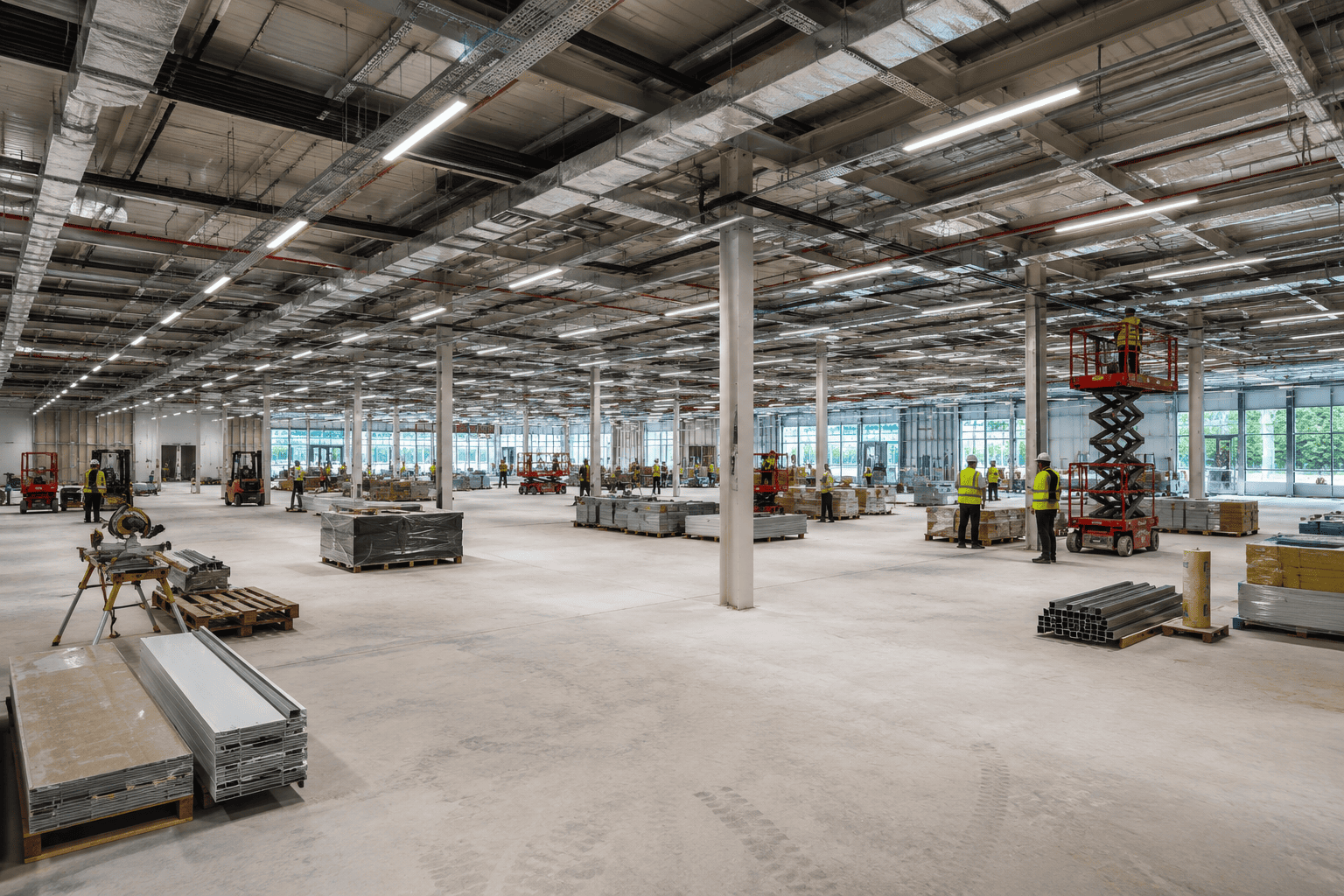
Most supermarket builds that go over budget do not fail because of bad luck. They fail because of decisions made in the first few weeks of a project that nobody challenged at the time.
Having delivered eleven supermarkets for Lidl, we have seen the same problems come up repeatedly. Not on our projects, but in the industry around us. Developers who came to us mid-build. Retailers stuck with a contractor who underpriced to win the job. The causes are almost always the same.
Here is what actually drives overruns on supermarket builds.
The Utility Problem Nobody Talks About
A supermarket needs serious power. A discount format store needs somewhere between 350 and 600 kVA depending on size and refrigeration load. A full-line supermarket needs more.
If the existing supply to the site cannot meet that demand, you need a new or upgraded connection from the local network operator. That process sits entirely outside your control. The network operator sets the timeline, not your contractor. And that timeline is typically 16 to 26 weeks from application to connection.
The problem is that developers often do not commission a utility capacity check until after they have committed to a programme. By the time the issue surfaces, the application should have gone in months earlier. The programme either slips, or the project opens with temporary power at significant ongoing cost.
Fix: get a utility capacity report before you set your programme. If an upgrade is needed, the application goes in before anything else.
Ground Conditions
Ground investigation reports get skipped or scoped too lightly to keep pre-contract costs down. Then groundworks start and the ground is not what anyone expected.
Made ground, contamination, old foundations from a previous building, high water table. Any of these can add weeks to a programme and significant cost to the groundworks package. None of them are unknowable. They are just not known because nobody paid for the investigation upfront.
A ground investigation on a typical supermarket site costs between £5,000 and £15,000 depending on size and complexity. The cost of discovering bad ground after you have mobilised is multiple times that, plus programme delay.
Fix: do the ground investigation before you price the job. Not after.
A Tender That Was Never Realistic
Some contractors price to win, not to deliver. They submit a number that gets them appointed, knowing the real cost will emerge through variations once the contract is signed and it is too late for the client to go elsewhere.
This is most common when the tender is awarded on price alone and the scope at tender stage is vague. Vague scope means a contractor can price what is explicitly described and exclude everything else. Those exclusions become variations. Variations have margin on top. The client ends up paying more than a realistic tender would have cost, plus the time and friction of arguing every change.
Fix: get the design to a proper level of detail before you tender. And compare tenders on what is included, not just the bottom line number.
Design Changes After Work Starts
Every design change after a supermarket build starts costs more than it would have cost at design stage. That is not a contractor trying to catch you out. It is just how construction works. Work gets undone. Trades return. Materials get wasted.
On a large format supermarket, the refrigeration layout drives almost everything else. The drainage positions, the floor slab penetrations, the electrical distribution, the ventilation. Change the refrigeration layout after groundworks have started and you are not changing one drawing. You are changing the programme for multiple trades simultaneously.
Fix: freeze the design before you start on site. Specifically freeze the refrigeration layout. Changes after that point are expensive.
Long Lead Items Ordered Too Late
Refrigeration plant, electrical switchgear, and specialist ventilation equipment all have manufacturer lead times. In 2025 those lead times sit between 10 and 20 weeks for most supermarket specification items.
If these items are not ordered at or before contract award, they will not arrive when the programme needs them. The programme then stalls waiting for plant. Trades that should be commissioning are standing around. Prelims are running. The contractor may be entitled to claim for the delay depending on who was responsible for placing the order.
Fix: identify every item with a lead time over six weeks at tender stage. Order them at or immediately after contract award. Do not wait for the design to be fully finalised if the lead time cannot absorb the wait.
Planning Conditions Not Discharged Before Start
Most supermarket planning permissions come with pre-commencement conditions. These are conditions that have to be signed off by the local planning authority before you can legally start work. Things like archaeological investigation, ecology surveys, drainage strategies, or materials approval.
Starting on site before these are discharged is a planning breach. But more commonly the issue is that the conditions are submitted but not yet approved when work starts. If the local authority comes back with queries, or if the condition triggers a requirement the design does not currently meet, work on affected elements has to stop.
Fix: get all pre-commencement conditions discharged before you mobilise. Do not assume the local authority will turn around approvals quickly. Build their response time into your pre-start programme.
Preliminaries Underpriced
Preliminaries are the costs of running the site. Site management, welfare, hoarding, temporary power, skips, insurance. On a supermarket build they typically represent 12 to 18 percent of the total contract value.
Contractors under competitive pressure sometimes price prelims too thin to bring the overall number down. If the programme then runs long for any reason, those prelims run over because the fixed costs of the site do not stop. That overrun either comes out of the contractor's margin or gets argued out through extensions of time and associated cost claims.
Fix: check how prelims are priced. A site manager, welfare facilities, and a security fence cost what they cost. If the prelims look thin relative to the programme length, ask why.
What to Do Before You Commit to a Budget
None of the problems above are unavoidable. They are all predictable if you know what to look for.
Before you commit to a budget on a supermarket build, you need:
- A utility capacity check, with an application in process if an upgrade is needed
- A ground investigation report that covers the full footprint and any areas of historic use
- A design that is detailed enough to tender properly, particularly the refrigeration layout
- A clear list of long lead items and a plan for when they get ordered
- All pre-commencement planning conditions identified and a realistic timeline for discharging them
- Tenders compared on scope, not just price
A contractor who has delivered multiple supermarkets will tell you all of this upfront. They have seen what happens when it is skipped. A contractor quoting their first or second supermarket is less likely to flag these risks because they have not lived through the consequences yet.
We have delivered eleven supermarkets for Lidl. Every one of those projects taught us something about where costs go wrong when the pre-contract work is not done properly. If you are planning a supermarket build and want a realistic view of what it will cost and what the risks are, talk to our team before you set your budget. Not after.
Recent Blogs
- Retail Construction in a Conservation Area: What Changes
- Planning Permission for Retail Construction: A Practical Guide for Developers
- How to Brief a Retail Contractor: What to Prepare Before You Go to Tender
- Shell and Core vs Full Fit Out: What the Difference Means for Your Budget and Programme
- CDM 2015 for Retail Clients: What Your Legal Duties Actually Are