What a Realistic Retail Fit Out Programme Looks Like Week by Week
June 23, 2026
Most retailers and developers get a programme from their contractor that looks clean on paper. Ten weeks, maybe twelve. Logical sequence. Everything falls into place.
Then the job starts.
Strip out reveals something nobody priced for. A specialist trade is waiting on a delivery that is three weeks late. Building control wants something revisited. Suddenly the handover date is a moving target.
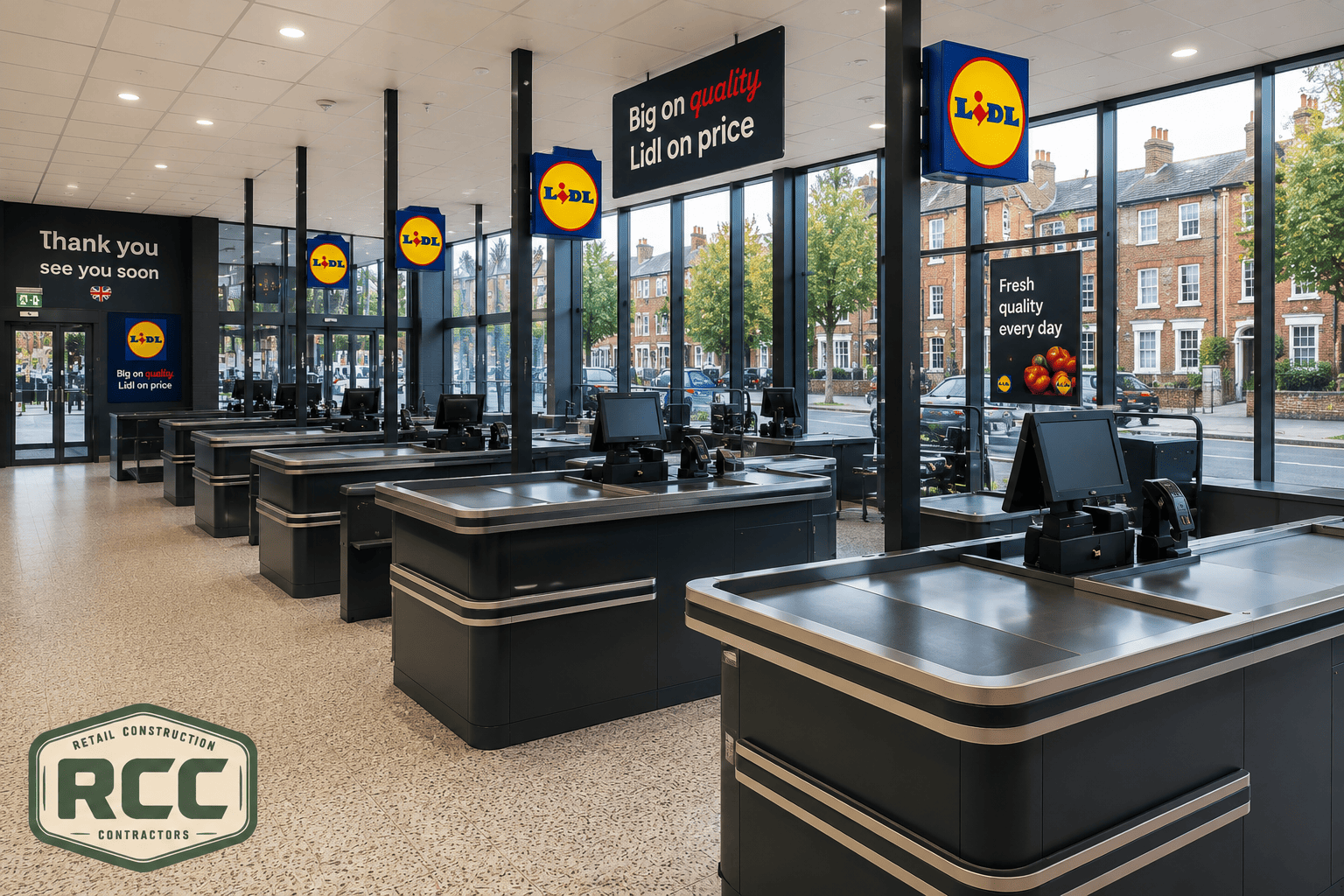
This post covers what a large format retail fit out programme actually looks like, not the version that wins tenders, but the one that reflects how these jobs actually run. We are writing from our experience delivering large format stores, including eleven Lidl supermarkets, so the timelines here come from real programmes rather than theory.
What Large Format Actually Means
For this post, large format means a retail unit of roughly 400 square metres and above. That covers food retail, discount supermarkets, large high street stores, and anchor units on retail parks.
At this size, a fit out is not a shopfit. You are dealing with significant mechanical and electrical installations, specialist refrigeration in food retail, commercial extraction, full compliance packages, and a programme that realistically runs 12 to 16 weeks from site start to handover. Anyone quoting you eight weeks for a unit at this scale either has a very generous definition of handover or is not pricing the full scope.
Before Week One: The Work That Has to Happen First
The programme clock usually starts at site mobilisation. But there is a body of work that has to be done before anyone sets foot on site, and if it has not been done, week one does not go as planned.
Before site start you need:
- Building regulations approval in place, not just submitted
- All design information issued and signed off, including M&E drawings and refrigeration layout for food retail
- Long lead items ordered, particularly refrigeration plant, electrical switchgear, and anything with a manufacturer's lead time over four weeks
- Utility applications submitted if the unit needs an upgraded supply
- CDM documentation ready, including the construction phase plan
The most common reason a programme runs late has nothing to do with what happens on site. It is that one or more of these things was not in place when the job started. A contractor who does not flag this clearly in the pre-start period is not doing their job.
Weeks 1 and 2: Strip Out and Enabling Works
Strip out is when you find out what you are actually dealing with. Previous fit out, redundant services, asbestos that was not on the register, structural alterations from a previous occupier that nobody documented properly. You will not know everything until the ceiling comes down and the floor comes up.
In weeks one and two on a large format unit you should expect:
- Full strip out of the existing fit out to shell
- Asbestos removal if the survey identified it, or further investigation if areas were not accessible before
- Surveys of existing drainage, electrical supply, and structural condition
- Site compound set up, welfare in place, deliveries route agreed
- Temporary protection to any retained elements
If the asbestos survey was done from common areas only, which happens more often than it should, you will get surprises behind plasterboard and above suspended ceilings. Budget for it and programme for it rather than hoping it does not happen.
Weeks 2 to 5: First Fix
First fix is where the building starts to take shape, but none of it is visible in the finished store. It is the infrastructure behind everything else and it has to be right before anything goes on top of it.
First fix on a large format unit covers:
- Groundworks: drainage runs, new floor slab or slab repairs, any below ground services
- Structural works: new openings, steelwork, any alterations to the shell
- Mechanical first fix: pipework for heating and ventilation, refrigeration pipework in food retail
- Electrical first fix: containment, distribution boards, cable runs throughout the unit
- Refrigeration first fix: pipework and drainage for chilled and frozen cabinets
In food retail, refrigeration first fix is the trade you build the rest of the programme around. The pipework runs are long, the connection points are precise, and the refrigeration plant itself often needs to be positioned and installed before other trades can finish around it. If refrigeration is late starting, everything downstream moves with it.
Weeks 5 to 8: Second Fix and Structure
Once first fix is complete and inspected, the unit starts to look like a building. Partitions go up, the ceiling grid goes in, and the second fix trades follow.
This phase covers:
- Partitions and internal walls to finished height
- Suspended ceiling grid and tiles
- Mechanical second fix: fan coil units, ventilation grilles, extraction hoods in food retail
- Electrical second fix: light fittings, sockets, containment lids, distribution board connections
- Refrigeration cabinets landed and connected
- Sprinkler installation if required
- Fire alarm devices and detection throughout
The sequencing of trades in this phase is where programmes are won or lost. If partitions are not complete when the ceiling grid needs to go in, you lose time. If electrical second fix cannot start because mechanical is still running pipework, you lose time. A contractor who is managing this phase properly is tracking trade progress daily, not weekly.
Weeks 8 to 11: Finishes
Finishes are the most visible phase but rarely the most complex. By this point the programme is set. If you are on track coming into week eight you will hit your handover date. If you are not on track by week eight, no amount of weekend working will recover more than a few days.
Finishes on a large format unit typically cover:
- Floor finishes throughout, screeds where required, final floor covering
- Painting and wall finishes
- Shopfitting and joinery, including checkout counters, service counters, and customer toilet fit out
- Signage and wayfinding
- External works, including car park markings, trolley bays, and any landscaping in scope
Food retail has one additional requirement here that catches people out: the cold chain has to be commissioned and running at temperature before any food grade finishes or seals go down around the cabinets. You cannot do that in the right order if refrigeration first fix was late.
Weeks 11 to 13: Testing, Commissioning, and Snagging
A large format retail fit out does not end when the last tile goes down. There is a commissioning and testing phase that cannot be rushed and cannot be skipped.
This covers:
- Electrical testing and certification, including EICR
- Ventilation commissioning and air flow balancing
- Refrigeration commissioning, temperature logging, and F-Gas certification
- Fire alarm commissioning and sign off
- Building control final inspection
- Snagging by the client and contractor, with a defined period for making good
On a food retail store, commissioning alone takes longer than most clients expect. Refrigeration systems need to run at stable temperature before they can be signed off. You cannot fast track that with extra labour. It takes the time it takes.
What Pushes Programmes Back
Most delays on large format fit outs come from the same causes. In order of how often we see them:
- Long lead items ordered late or not at all before site start, most often refrigeration plant and switchgear
- Design information still being finalised after work has started, which means trades are waiting or working off incomplete drawings
- Utility upgrades needed but not applied for until after mobilisation, the network operator lead time is outside anyone's control once you have missed the window
- Strip out revealing ground conditions or structural issues that were not known before
- Building regulations queries that stop a trade mid-phase while the design team responds
- Subcontractors double-booked because the programme slipped and they have moved on to another job
None of these are unusual. They are the normal risk on this type of project. The difference between a contractor who manages them and one who does not is whether these risks are identified and mitigated before they become programme events, not after.
What a Realistic Programme Looks Like
For a large format retail fit out of 400 to 800 square metres, with full M&E, commercial extraction, and refrigeration for food retail:
- Pre-start preparation: 4 to 6 weeks before site mobilisation
- Strip out and enabling: weeks 1 to 2
- First fix: weeks 2 to 5
- Second fix and structure: weeks 5 to 8
- Finishes: weeks 8 to 11
- Testing, commissioning, snagging: weeks 11 to 13
- Handover: week 13 to 14
That is a 13 to 14 week on-site programme for a straightforward large format unit. Add two weeks if the shell condition throws up structural or drainage issues at strip out. Add two to three weeks if refrigeration or utility connections have a long lead time that was not managed early.
A contractor quoting ten weeks for this scope is either cutting the commissioning phase, assuming snagging is your problem, or has not priced the job properly. Ask them which it is.
Questions Worth Asking Before You Appoint
- What is your pre-start process and what do you need from us and the design team before you mobilise?
- When do long lead items need to be ordered and who is responsible for placing those orders?
- Have you done food retail fit outs with live refrigeration commissioning, and can you show us a programme where that went to plan?
- Who is on site every day managing the trades, and what is their background?
- What is your process when strip out reveals something that was not in the scope?
A contractor with real experience on large format fit outs answers all of these without hesitation. The answers come from jobs they have actually run, not from what they think you want to hear.
We have delivered eleven Lidl supermarkets and a range of large format retail fit outs across the UK. If you want a realistic programme for your project rather than an optimistic one, get in touch with our team. We will tell you what your job actually involves before you commit to a start date.
Recent Blogs
- Retail Construction in a Conservation Area: What Changes
- Planning Permission for Retail Construction: A Practical Guide for Developers
- How to Brief a Retail Contractor: What to Prepare Before You Go to Tender
- Shell and Core vs Full Fit Out: What the Difference Means for Your Budget and Programme
- CDM 2015 for Retail Clients: What Your Legal Duties Actually Are