Refrigeration and F-Gas Compliance for Food Retail Construction
July 13, 2026
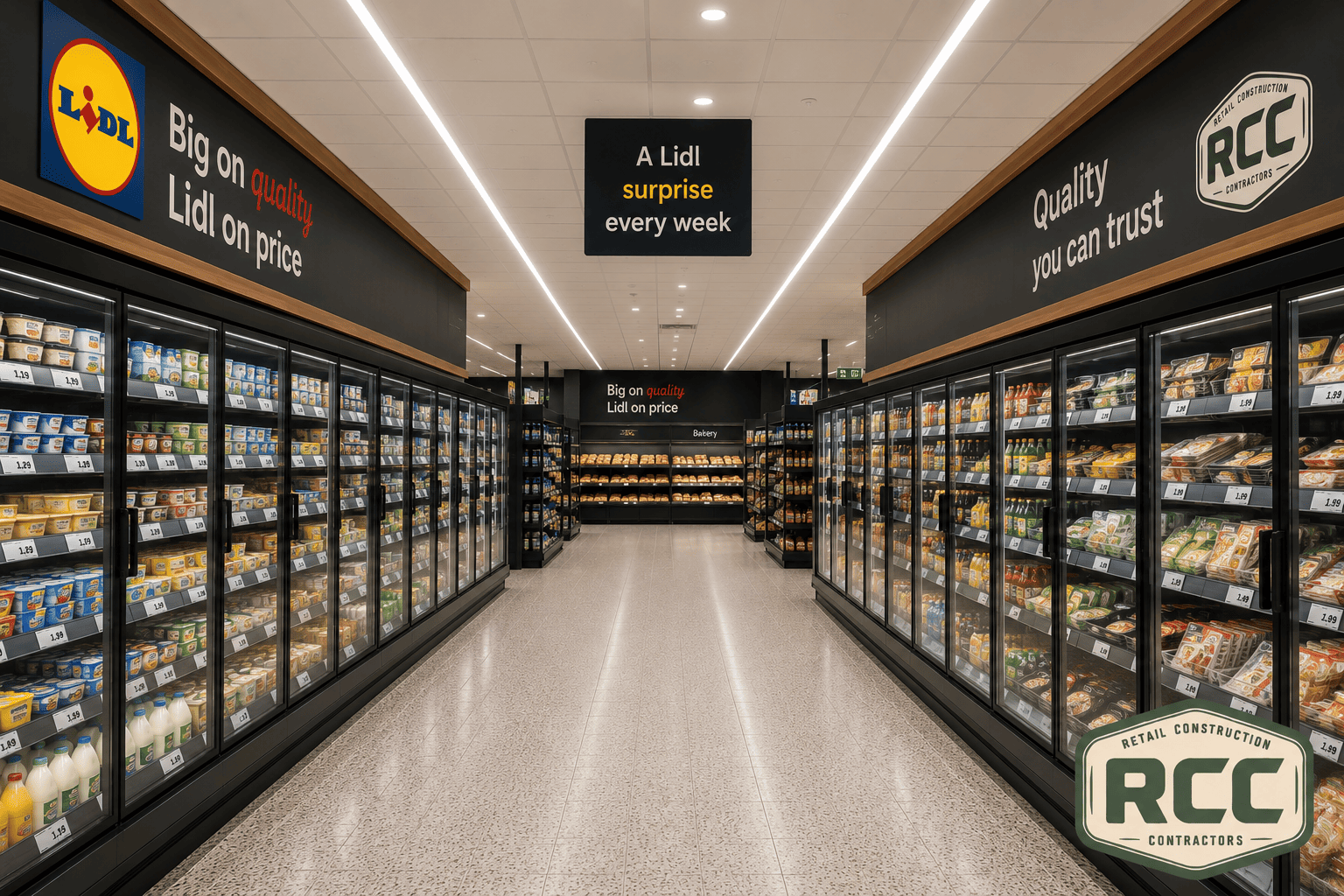
If you are building or fitting out a food retail unit in the UK, refrigeration is not just a specification decision. It is a compliance one. The refrigerants used in commercial refrigeration are regulated under UK F-Gas legislation, and getting that wrong has consequences that go beyond a fine. You can end up with a system you cannot legally service, a store that cannot open, or a stock loss claim your insurer refuses to pay.
Most developers and retailers hand this off entirely to their refrigeration contractor and assume it is sorted. Sometimes it is. Sometimes the issue only surfaces when commissioning reveals a system that does not meet current requirements, or when a maintenance call reveals that the refrigerant in the cabinets is already restricted.
This post explains what F-Gas compliance actually means for a food retail build, what the rules require, and what to get right before the refrigeration package is specified.
What F-Gas Regulation Actually Is
F-Gas stands for fluorinated greenhouse gas. The gases in question are hydrofluorocarbons, or HFCs, which are the refrigerants used in the vast majority of commercial refrigeration equipment. They are very effective at cooling. They are also potent greenhouse gases. R-404A, still found in older retail refrigeration equipment, has a global warming potential of 3,922. That means one kilogram leaking to atmosphere does the same climate damage as nearly four tonnes of CO2.
In Great Britain, the regulatory framework is the Fluorinated Greenhouse Gases Regulations 2015, which retained the EU F-Gas framework into domestic law after Brexit. Northern Ireland follows the updated EU regulation under the Windsor Framework, so the rules are slightly different if your store is there. The practical effect for a food retail operator in England, Scotland, or Wales is the same: your refrigeration system is subject to legal requirements on the refrigerants it uses, who can work on it, how often it must be checked for leaks, and what records you must keep.
The full guidance is published on GOV.UK and covers operators, engineers, and companies in detail.
The Refrigerant Phase-Down and What It Means for New Builds
The UK is committed to phasing down HFC refrigerants by 79 percent against the 2009 to 2012 baseline by 2030. Defra ran a consultation in late 2025 on tightening that schedule further from 2027, and while no new legislation had been confirmed at the time of writing, the direction is clearly toward faster restriction, not slower.
For a new food retail build, the practical effect is this. If you specify refrigeration equipment that uses a high global warming potential refrigerant today, you are building a system that may be increasingly difficult and expensive to service within the life of your lease. The restrictions that are already in force make the point clearly:
- Since 2020, virgin R-404A cannot be used to top up refrigeration systems with a charge above 40 tonnes of CO2 equivalent. Reclaimed or recycled R-404A is permitted until 2030, but supply is restricted and prices have risen significantly as a result.
- From January 2025, the ban on using virgin refrigerants with a global warming potential above 2,500 applies to systems of any size, not just those above the previous threshold. R-404A, with a GWP of 3,922, is caught by this ban.
- The phase-down schedule is tightening. Less HFC refrigerant is permitted on the market each year, which pushes prices up regardless of what specific bans are in force.
For a new build, the answer is straightforward: specify equipment that uses low global warming potential refrigerants from the start. R-290 (propane) is now widely used in self-contained plug-in units. CO2, known as R-744, is increasingly specified for larger central pack systems in food retail. These are not experimental choices. They are what the major supermarket operators are already installing at scale.
Specifying high GWP refrigerant in a new food retail fit out in 2026 is a decision that will create compliance and cost problems within the operational life of the store. Any refrigeration contractor who does not raise this with you at specification stage is not doing their job.
Who Is Responsible for Compliance
This is the part that catches operators out most often. The legal duty under F-Gas regulation sits with the operator, meaning the business that runs the equipment, not the contractor who installed it. You can outsource the work. You cannot outsource the liability.
If your refrigeration system leaks and you cannot produce a current F-Gas register and records of leak checks, the Environment Agency can issue civil penalties. More practically, insurers are increasingly treating an incomplete F-Gas register as evidence of non-compliant maintenance when processing stock loss claims. A claim for spoiled stock that cannot be supported by maintenance records is a claim at risk.
Your legal duties as an operator include:
- Ensuring leak checks are carried out at the required frequency by a certified engineer
- Keeping records of the refrigerant type and quantity in each system, leak checks carried out, and any refrigerant added or recovered
- Ensuring any company working on your refrigeration holds current F-Gas company certification from an approved body
- Ensuring refrigerant is handled only by individually certified engineers
Leak Check Frequency
How often you need to check for leaks depends on the size of your system, measured in tonnes of CO2 equivalent. To calculate your system's CO2 equivalent, multiply the refrigerant charge in kilograms by the global warming potential of the refrigerant and divide by 1,000.
The thresholds that trigger different requirements are:
- 5 to 49 tonnes CO2 equivalent: leak check required every 12 months, or every 24 months if automatic leak detection is fitted
- 50 to 499 tonnes CO2 equivalent: leak check required every 6 months, or every 12 months with automatic leak detection
- 500 tonnes CO2 equivalent and above: leak check required every 3 months, or every 6 months with automatic leak detection
A typical food retail unit with multi-deck chilled displays and frozen cabinets will almost certainly exceed the 5 tonne threshold. A large format supermarket running a central pack system will typically be well above 50 tonnes. The full guidance on thresholds and calculation is on GOV.UK.
Automatic leak detection is worth specifying for new builds. It reduces the required check frequency, which reduces ongoing compliance cost, and it catches leaks faster, which reduces refrigerant loss and the associated cost of topping up.
Who Can Work on Your Refrigeration System
Only engineers who hold personal F-Gas certification from a government-approved awarding body can carry out regulated work on your refrigeration system. Regulated work includes installation, servicing, maintenance, leak checking, and refrigerant recovery. This is not something to assume. Before any refrigeration engineer works on your system, ask for their certification.
The company employing or contracting those engineers must also hold F-Gas company certification. Individual and company certification are separate requirements. Both must be in place.
Sending an uncertified operative to top up a cold room or investigate a leak is a legal breach. It is also a risk to the integrity of the system. The regulations exist because refrigerant handling requires specific training. A poorly handled recovery or charge can damage equipment and create safety risks.
What This Means for the Construction Programme
F-Gas compliance affects the construction and commissioning programme in three ways that are worth understanding before work starts.
First, refrigerant specification affects procurement lead times. CO2 systems and R-290 equipment are increasingly available off the shelf from major manufacturers, but the lead times for larger central pack systems can be significant. This needs to be confirmed at specification stage, not after the programme is set.
Second, commissioning a refrigeration system takes time. The system needs to run to stable operating temperature before it can be signed off. You cannot rush that process. For a food retail store, commissioning of the refrigeration system sits on the critical path, and it must be complete before any food-grade finishes or seals go down around the cabinets and before stock can arrive.
Third, the F-Gas commissioning certificate is a handover document. It records the refrigerant type and charge for each system, and it is the starting point for your ongoing F-Gas register. A contractor who hands over a store without complete F-Gas documentation is leaving the operator without the records they are legally required to have from day one of trading.
What to Confirm Before the Refrigeration Package Is Specified
- What refrigerant will be used in each system, and what is its global warming potential? If any refrigerant has a GWP above 750, ask why a lower GWP alternative has not been specified.
- Does the refrigeration contractor hold current F-Gas company certification, and can they confirm that every engineer who will work on the system holds individual certification?
- Will automatic leak detection be fitted, and where will the detection points be located?
- What is the lead time for the specified equipment, and when does the order need to be placed to hit the commissioning date on the programme?
- What F-Gas documentation will be included in the handover package, and who is responsible for producing it?
What to Ask Your Contractor
- Have you designed and commissioned refrigeration systems for food retail before, including central pack systems?
- What refrigerants are you specifying for this project and why?
- How do you handle the F-Gas handover documentation, and who will complete the initial equipment register?
- What is your commissioning process for bringing the system to operating temperature, and how long does that take for this configuration?
A refrigeration contractor with food retail experience answers all of these specifically. One without it tends to default to familiar refrigerants without considering the compliance trajectory, and leaves the operator to work out the documentation requirements after handover.
The Honest Summary
F-Gas compliance for food retail refrigeration is not complicated, but it needs to be considered at specification stage, not after commissioning. The refrigerant you specify today determines how serviceable and compliant your system will be across the life of the lease. The documentation produced at handover is the foundation of your ongoing legal compliance. And the operator, not the contractor, carries the liability if any of this is not in order.
We have delivered eleven Lidl supermarkets and a range of food retail fit outs across the UK. Refrigeration specification and F-Gas compliance are part of every food retail programme we run. If you are planning a food retail build and want to understand what the compliance picture looks like for your specific project, get in touch with our team. We will work through the requirements with you before the specification is set.
Recent Blogs
- Retail Construction in a Conservation Area: What Changes
- Planning Permission for Retail Construction: A Practical Guide for Developers
- How to Brief a Retail Contractor: What to Prepare Before You Go to Tender
- Shell and Core vs Full Fit Out: What the Difference Means for Your Budget and Programme
- CDM 2015 for Retail Clients: What Your Legal Duties Actually Are